I · Smallness
A scale we can hold in mind
We do not want to be bigger than one parish. Bigger would be different work, asking different questions of trustees. We do not want that.
Our mission
The mission of Great Barr Church Lands is set down in seven plain charitable objects in our 1891 Scheme. Below is what those objects look like in 2026 — the values we hold, the theory of change we follow, and one honest paragraph about what the trust cannot do.
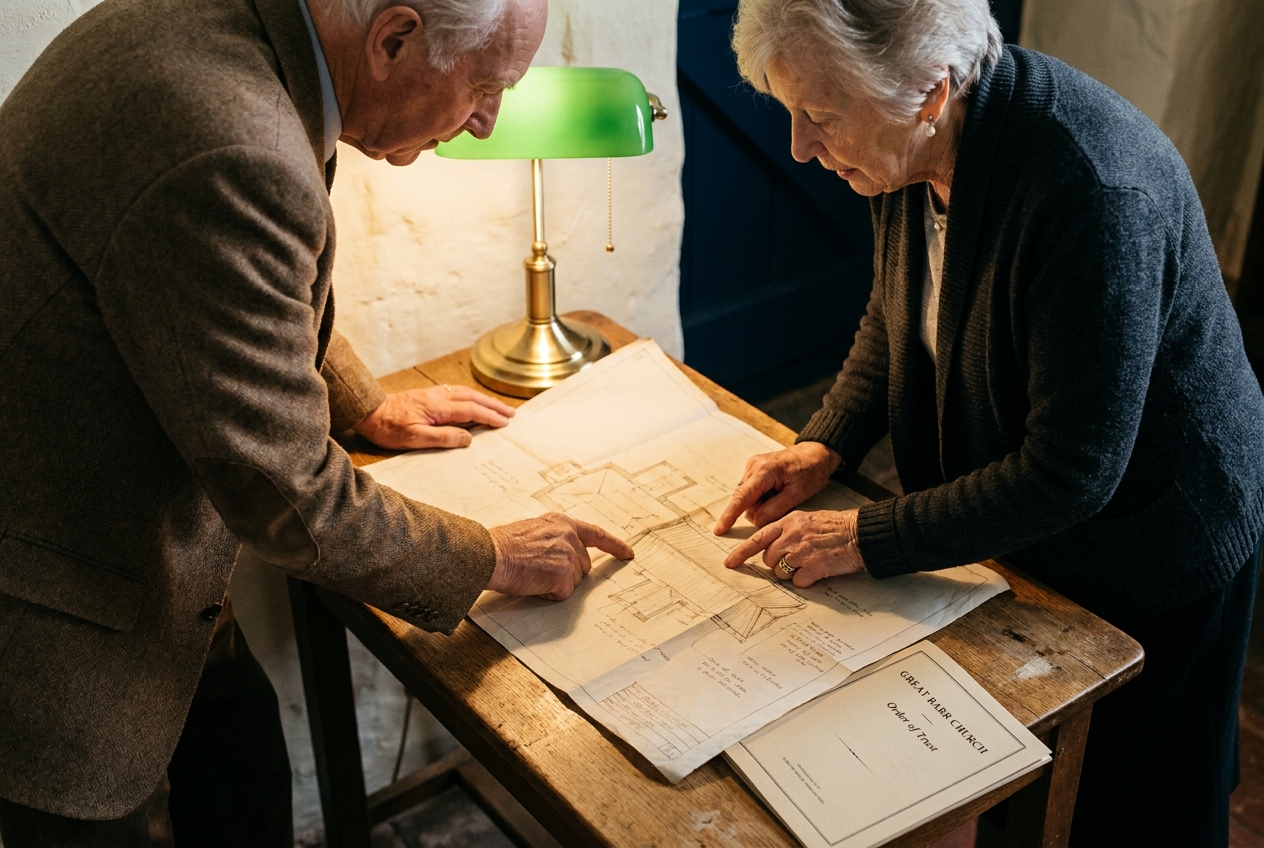
Above · Mark Howell and June Aubrook reviewing the south aisle drawings, parish room, March 2026.
Five values
I · Smallness
We do not want to be bigger than one parish. Bigger would be different work, asking different questions of trustees. We do not want that.
II · Patience
The bells were recast in 1922 after they had been allowed to grow sour for a decade. We measure our planning in decades, not in quarters.
III · Plainness
The objects of the trust are written in plain Victorian English. We try to write our annual reports in the same register: short sentences, named people, real numbers.
IV · Custody
We are not delivering a programme. We are looking after one building, one graveyard, one weekly liturgy, year on year on year.
V · Openness
Our accounts, register of trustees, conflicts policy and grant decisions are on the public record. If a question is asked, we answer it in writing within ten working days.
Theory of change
Our theory of change is unfashionably linear. A small endowment, invested patiently, produces a small annual income, applied to a small set of named works, with one outcome: a parish church that is sound a year hence.
Inputs
An invested capital base, augmented annually by parish gifts and the occasional bequest.
Activities
Fabric grants, graveyard care, parish clerk's stipend, vestments grants, Divine Service Fund, the Restoration Reserve.
Outcome
Each year, St Margaret's reopens its doors on Christmas Eve weather-tight, well-lit and provisioned for the worship of the parish.
A plain paragraph
It is worth saying plainly. Great Barr Church Lands is not a community charity. The objects do not allow us to fund foodbanks, soup runs, mental-health support, refugee work, schools, scouts, or any of the many causes that this corner of the West Midlands needs. From time to time we are asked, very reasonably, whether we could 'broaden out'. The answer is no. The Charity Commission Scheme that brought us into being is binding on the trustees; we are restricted to seven plain ecclesiastical objects and may not stray from them. We respect the patient legality of that restriction.
We have also, on more than one occasion, failed at things we did try to do. The 2014 attempt to open the church for weekday tourism foundered after eighteen months — visitor numbers were lower than we had hoped, and the cost of stewarding was higher; we wound it up rather than carry an unsustainable commitment. Our 2019 application to the National Lottery Heritage Fund for an enlarged Burial Records project was unsuccessful; we re-scoped to a smaller, parish-funded version which is now thriving. We mention both because the parish should know what its trust has tried, not only what has worked.
If you would like to help