
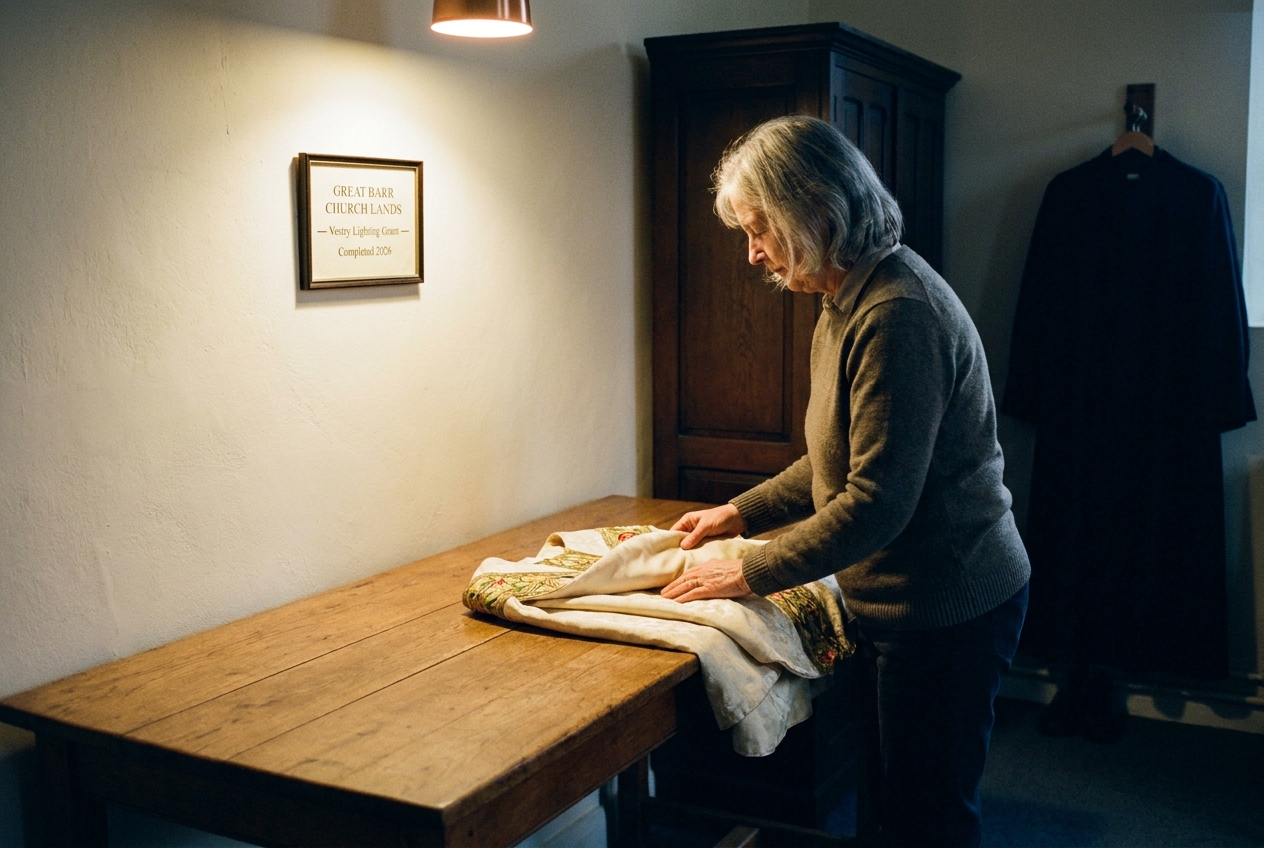
The first thing Margaret Wittall said, on the morning the new fittings were finally switched on, was: 'I had forgotten that this room had corners.' She has been folding vestments at St Margaret's every Saturday morning for thirty-one years. For most of those years a single 100-watt tungsten pendant hung at the centre of the ceiling, throwing a yellow cone of light onto the long oak side-table and very little anywhere else. The corners of the vestry — the cope-cupboards, the linen press, the wash-stand against the north wall — sat in a gentle and persistent twilight.
You will perhaps imagine a vestry as a small, decorative thing, with stained-glass panels and a strip of carpet. The vestry at St Margaret's is in fact a workshop. It is where the chasubles are pressed; where the altar linen is folded; where the wine is decanted into the cruets; where the registers are signed after a wedding. It is, for several hours every week, the most used room in the parish, and for thirty years its working light had been worse than the light in most of our volunteers' garden sheds.
The reason for that delay is worth recording, because it is the kind of small bureaucratic stubbornness that often holds back a small charity. When the question first came to the board, sometime in the late 1990s, the trustees of the day were warned that any electrical work to a Grade II*-listed church would require both faculty consent from the Lichfield Diocesan Advisory Committee and listed-building consent from the local planning authority — and that the cost of the consents themselves might exceed the cost of the lighting. The minute-book records, in the tidy handwriting of the then-Secretary, the dry verdict: 'Deferred.'
'I had forgotten that this room had corners. I had not seen the back of the cope-cupboard since the year my husband died.'Margaret Wittall · Vestry warden, St Margaret's, 1995 to date
Deferred is what small charities do best. The vestry pendant went on lighting the cone of the side-table; the linen press receded into shadow; Margaret learned to fold by touch. In 2014, when the south aisle leadwork campaign was set going, the trustees again revisited the question. Again it was deferred, this time for the better reason that the south aisle had to come first.
What changed, finally, was a piece of guidance issued by the Church Buildings Council in February 2024. Under a streamlined faculty procedure for 'minor reversible improvements to the working areas of historic churches', the consent timetable for our vestry came down from nine months to ten weeks, and the cost of the consent itself from approximately £1,800 to about £240. The way was clear. A specification was prepared with the Diocesan Architect by 16 May 2025; the work was put out to two craft firms in the West Midlands; a tender of £2,840 was accepted at the trustees' meeting of 7 October 2025; the new fittings — three wall-mounted brass lanterns and a single dimmable conservation pendant — were commissioned on Wednesday 11 March 2026.
The scheme is reversible. Every fitting can be removed in an afternoon without leaving a mark on the historic fabric. The bulbs are 2,700 K — warm, not blue — and the dimmer is set so that, on a Sunday morning when the linen has only to be glanced over, the level is no greater than it was under the old pendant. It is, in the language of the new guidance, a minor reversible improvement. In the language of Margaret Wittall, it is the first time she has seen the back of the cope-cupboard since the year her husband died.
Why does this matter to a trust which exists for the maintenance of fabric and the provisioning of Divine Service? Because the seventh of our objects names 'expenses incurred in the performance of Divine Service' — and the folding of vestments, the inspection of linen, the pressing of a chasuble, are all, plainly, part of that performance. The 1891 Scheme had a wider sense of those expenses than we have sometimes allowed ourselves. It included the dignity of the room in which the cloths are prepared.
It is also, in a very small way, a victory of patience. The trust took three decades to do this work. It did it because someone — in fact, several someones — kept the question alive at the board until the regulatory window opened. We have other questions like that on our list: the easing of the south path; the rehanging of the north-aisle gate; the digitisation of the marriage book. Some of them will wait for another regulatory window. Some will wait simply because there is no money for them yet. All of them have a chance of being done, eventually, if they are not allowed to drop off the agenda.
I asked Margaret, on the second Saturday after the lights were commissioned, whether the new scheme changed anything about her routine. She thought about it for a long minute, with the chasuble half-folded over her arm. 'I think,' she said, 'I will have to slow down. I can see what I am doing now.' She laughed. 'That is going to take some getting used to.'
Christopher Pritchard is the Secretary of Great Barr Church Lands. He writes the Quarterly Dispatch and occasional longer pieces. A printed copy of this article is available on request from the parish office in Streethay.