
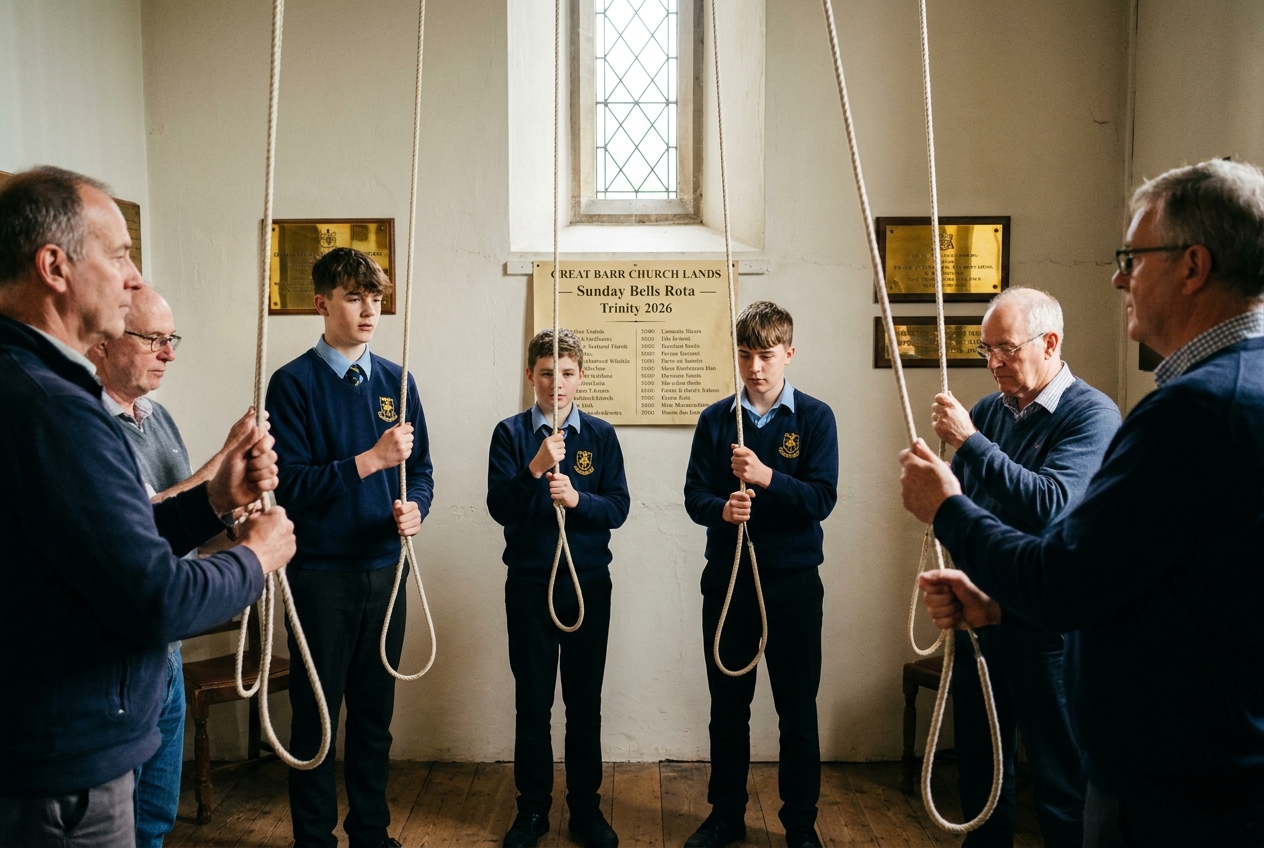
When Thomas Whitley took over as Tower Captain of St Margaret's at the end of 2021, he inherited eight bells (recast at Taylor's of Loughborough in 1922), a wood-panelled ringing chamber with a tungsten pendant and a single radiator, and a band of four very faithful ringers, all of whom were in their late sixties or above. The youngest member of the band, by some distance, was a retired chemistry teacher who had moved into the parish from Streetly in 2008. Thomas asked me, gently, if the trust could find £640 to replace three of the older sallies — the long woollen tail-ends of the ringing ropes — because they had grown matted and slippery after fifteen years of use and were, he said, 'making it harder than it needs to be for a beginner to learn'.
The trust agreed without much discussion. £640 is a very small expenditure within an annual fabric budget of nine or ten thousand. The sallies were ordered, in cream and navy, from a small bell-rope maker in Bristol. They arrived on the morning of 14 February 2022. Thomas hung them, with the help of Edward Marshall, that afternoon. The Sunday band rang on the new sallies on 20 February for the first time. So far, so undramatic.
What followed was the thing the trust had not quite anticipated. Within six months, the Tuesday-night beginners' practice — which had been going for a year with two regular learners and a great deal of patience — picked up four new ringers in a single autumn. By Easter 2023 the beginners' band was eight. By the end of that year the Tower Captain was running two practices a week to fit everyone in. By the time I sat down with Thomas to write this piece, in late January 2026, the working roll of Tuesday ringers stood at twelve, of whom three were under eighteen, four were under thirty, and one was a recent retiree who had heard the bells on a walk and asked if she could join in.
'Old sallies do not stop you learning. They just make every Tuesday harder than it needs to be. We took that harder Tuesday away.'Thomas Whitley · Tower Captain, in conversation, January 2026
It is tempting to claim, on behalf of the trust, that the £640 was somehow strategic. It was not. It was a small piece of routine maintenance which the trust met because Thomas asked for it and because it was clearly within the seventh of our objects — the ecclesiastical purposes of the Church of England — and because no one on the board could think of a good reason to say no. What did the work, in the years that followed, was Thomas himself. He turned up every Tuesday, for an hour and a half, regardless of weather, regardless of whether one beginner came or four. He laid out four chairs and two ringing belts every week. He kept a small kettle in the ringing-chamber cupboard so that anyone who wanted a cup of tea could have one. He learned the names of three teenagers' parents and asked, by name, how they were.
The sallies, in other words, were not the reason. They were the small bit of work the trust could do to make Thomas's patient work a little easier. That is, in my experience, the most useful thing a small grant-making trust can ever do. We cannot run a Tuesday-night practice. We do not know how to teach a thirteen-year-old to ring bob doubles. What we can do is keep the ropes good, the radiators on, the bulbs replaced and the room warm. The people who do the real work then have one less small obstacle in their week.
I tell the story partly because I am proud of Thomas and the band, and partly because I want to be careful about the moral. We are sometimes tempted, when a small grant has a happy outcome like this, to claim it as proof that small grants do big work. They do not. People do big work. Small grants take small obstacles away so that the people doing the big work can do a little more of it, or do it a little more easily, or carry on for a little longer.
The trust this year has approved the renewal of the tower's heating thermostat — a £180 disbursement, agreed at the November meeting on Thomas's request. It is not a glamorous line in the accounts. If, in eighteen months' time, the Tuesday band has grown again to fifteen, it will be because Thomas is still turning up. The thermostat will simply have meant that the chamber is at sixteen degrees instead of thirteen by the time the first ringer arrives.
Come and listen on a Tuesday from 19.30, if you are at all curious. Thomas will give you a cup of tea, and an apple if you want one, and let you stand quietly at the back and watch. If you decide you would like to try, he will give you a sally and stand behind you for the first stroke. There is no commitment. There is, at the end of the evening, a quiet walk down through the parish in good company. That is, in the end, what the trust pays for.
Mark Howell is the Chair of Trustees of Great Barr Church Lands. He has served on the board since 2018.