The first Annual Naming at St Margaret's, Great Barr, was held on All Souls' Day 1972. The minute-book records that it was led by the then-Rector, the Reverend John Eastman, that the weather was 'unusually mild for the time of year', and that there were 'between forty and fifty present, mostly families of those interred in 1972'. There is no photograph. There is no surviving order of service. There is only the entry, in the bound minute-book of the trust, recording a small disbursement of £1.40 for candles and printed cards. Almost everything we now do on the evening of 2 November we have learned, slowly, from that first attempt.
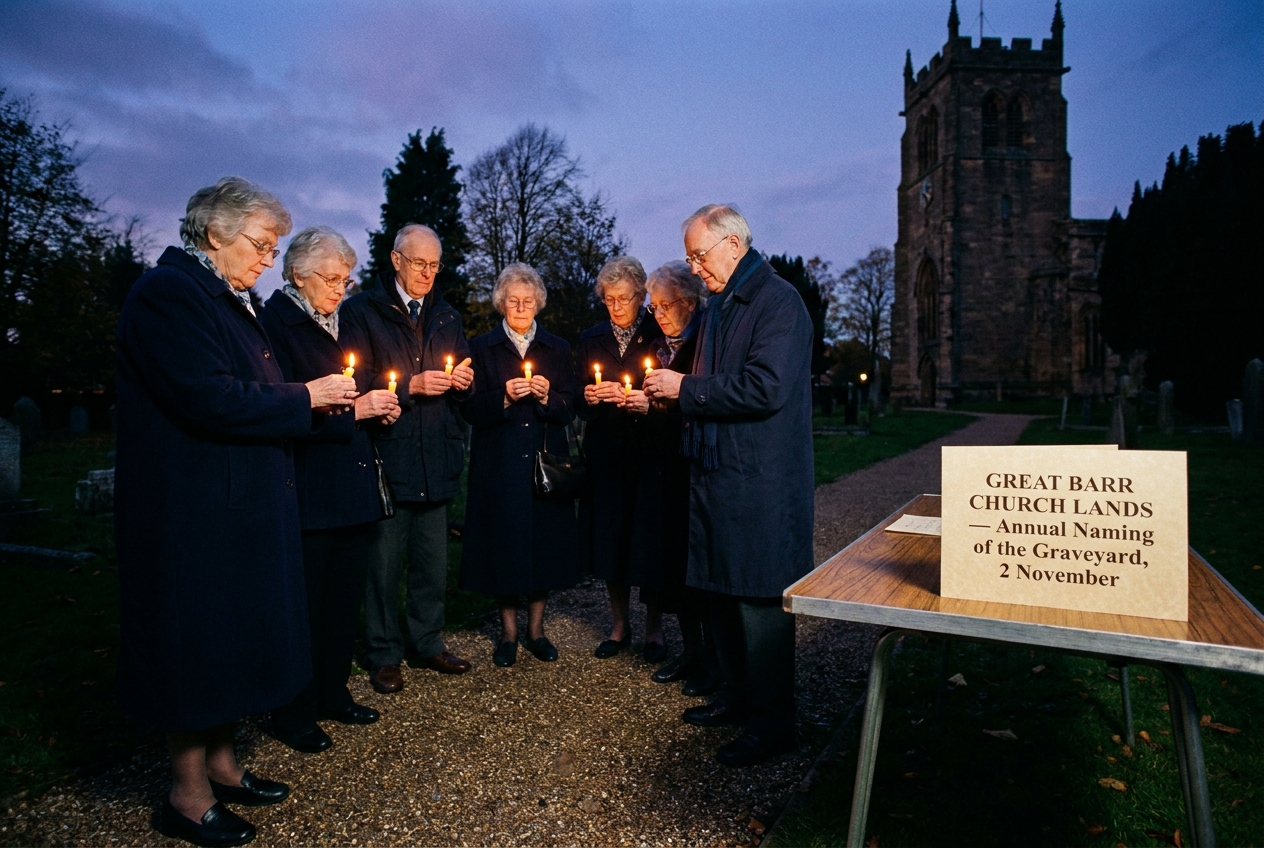
The form of the service is plain. At six o'clock, in whatever weather, the small congregation gathers under the south yew. The Rector reads aloud, slowly, the name of every person who has been buried in the south yard between the previous All Souls' and this one — usually between twelve and twenty names. After each name there is a long pause. A candle is lit and placed in a low stone niche on the south wall. There is no music; there is no homily; there are no extra words at all. The whole service lasts about twenty-five minutes, depending on how many names are to be read.
I have helped run the Annual Naming since 1986. It is, in my opinion, the truest piece of work the trust does. It does not raise money; it does not enlarge the fabric; it does not appear in our impact statistics. It only refuses, for one evening every year, to let the people of this parish slip out of memory at the speed the world would prefer them to slip out. Margaret Wittall (who herself helped run the service for nine years) once put it this way to me: 'We say their names because if we do not, no one will, by next Easter.'
'We say their names because if we do not, no one will, by next Easter.'Margaret Wittall · Vestry warden, in conversation, 2019
The trust pays for three things in connection with the service. The first is the printing of the cards: fourteen cream cards in a classical serif, ordered each October from a small letterpress shop in Walsall, listing the names that will be read so that families can take them home afterwards. The second is the candles: seventy-four small beeswax candles in low brass holders, lit on the night, gathered up the next morning, the unburned remainder kept for the next year. The third is the simple refreshment in the parish room afterwards — tea, a fruit-cake, sometimes a small loaf — for any of the families who wish to stay. The total cost, in 2025, was £163.20.
That is, on any measure, a small expenditure. We have argued about it twice in the last forty years — once in 1982, when the late June Garbett (no relation to the present senior trustee) suggested that the candles were dangerous in November weather; once in 2003, when a particular family wanted to add longer readings between the names. Each time the board, after a quiet meeting, returned the service to its original plain form. We have come to think the plainness is the point. There is something about the long pause after each name that does its own quiet work in the people who are present, and you cannot get to that pause by adding to the service.
What have we learned in fifty-three years? A few things. We have learned that the service should be at six, and not at four-thirty as some have suggested, because the dark is part of the service; without the dark, the candles do not mean what they should mean. We have learned that we should never advertise it more widely than the parish notice-board and the printed pew sheet, because a large congregation changes the character of the small one. We have learned that we should always have at least two candles in reserve in the parish-room cupboard, because the wind does, occasionally, take them. And we have learned that the people who come are not always the people we expected; people come whose connection to the parish is twenty years old or fifty, and the service holds them.
The Charity Commission, if it were ever to ask, would find this expenditure squarely within our seventh charitable object — the ecclesiastical purposes of the Church of England generally. It would also find it squarely within the spirit of the trust, which has from 1891 understood its work as the slow keeping-faith with a place and its people. The fourteen cream cards and the seventy-four candles are not a programme. They are how a small charity remembers what it is for.
I will be at the south yew again this November the 2nd. So will Edward Marshall, who took these photographs. So will, I hope, a few people who have never been to an Annual Naming before. The names will be read; the candles will be lit; the pause will do its work. You are very welcome.
June Aubrook is the senior trustee of Great Barr Church Lands and the lead trustee for the Graveyard Trust programme.